
Il Castello di Vogelod

Translated from the Italian. Titles, names, venues and press headlines are kept as originally published.
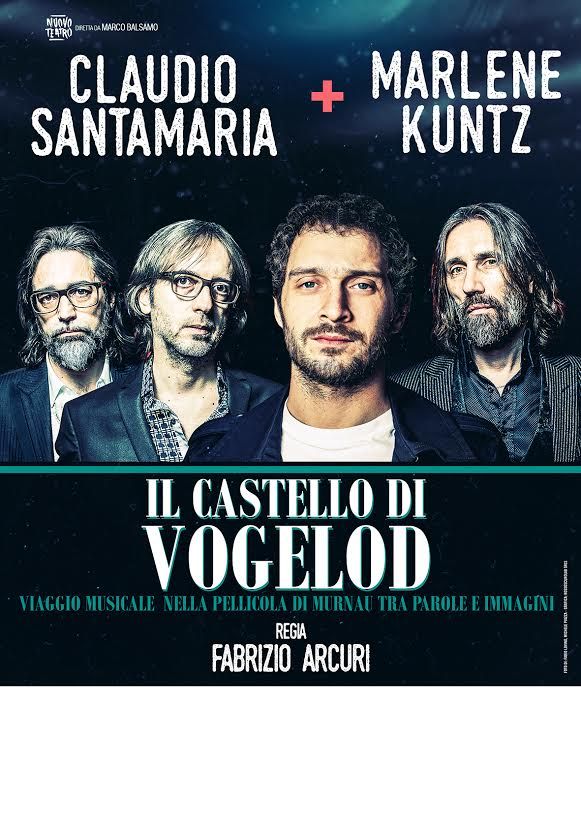
CLAUDIO + MARLENE
SANTAMARIA KUNTZ
in
IL CASTELLO DI VOGELOD
Viaggio musicale nella pellicola by Murnau tra parole e immagini
voce e live electronics CLAUDIO SANTAMARIA
colonna sonora e sonorizzazione live MARLENE KUNTZ
directed by
FABRIZIO ARCURI
With thanks to the Museo Nazionale del Cinema
Lo spettacolo ha debuttato to Teatro Ambra Jovinelli by Roma on 24 October 2017.
Faced with a masterpiece of silent cinema, one is spellbound by the rigour of its images and by the ability of pure cinema to probe looks and actions. This film in particular is extremely theatrical in its plot and in the claustrophobia it manages to create while always remaining within four walls.
Based on Rudolf Stratz's novel of the same name, the film has the power to make the audience believe that the border between suspicion and certainty is never clear-cut, and that something or someone is always able to blur them. The direction is an all-seeing eye that films trees and mountains as a whole and sets them against claustrophobic interior shots, because Murnau's gaze lurks wherever his probing eye can capture the secrets of his stories. By focusing on the expressions of certain faces, the psychological use of space is exploited to the full, outlining the meaning of what is happening to the characters inside the manor. In this way horror penetrates from outside and from inside, from the present as well as from the past (flashbacks are used extensively). The sets, in this respect, are natural, while the light is more artificial, seeming to come from a distant past, breaking the characters' calm and bringing them into relation with one another.
Over the film's direction lies a stage direction that heightens and amplifies the tension, thanks to the soundtrack by Marlene Kuntz – the Italian rock band known for their sensitivity and their refined sounds, rough and melodic at once – to a moving set of real objects and screens that gives the film a three-dimensional space, so that the audience can take a journey inside the film, and finally to the voice and performance of Claudio Santamaria, who is both narrator of the story and an actor on stage. At times the film takes on real body, only to lose itself again in the virtuality of the images, in a constant counterpoint of truth and fiction, an infinite play of mirrors that maximises the thriller vocation of this film, which launched the strands of cinema that would later form a genre of their own – the 'giallo' – always much loved by audiences, contemporary ones included.
Plot of the film
Gathered in a castle for a hunt, a group of society men are forced to spend their time indoors because of terrible weather. They are joined by Count Johann Oetsch, who was not invited and whom everyone avoids because he is rumoured to have caused his brother's death – a rumour fuelled by a retired judge.
Baroness Safferstätt arrives at the castle: the dead man's widow, now remarried. The simultaneous presence of Oetsch and the Baroness embarrasses the guests, but the Baroness decides to stay and wait for Father Faramund, her late husband's spiritual adviser, to whom she wishes to confess. In the following days Oetsch, the Baroness and her husband Safferstätt accuse one another of the murder. Until the Baroness confesses that her previous marriage was turning out to be a failure, her husband increasingly interested in spiritual matters rather than in her. One evening, in the presence of Safferstätt, a long-standing friend of her husband, she had expressed the need for something transgressive to take her away from good feelings. Safferstätt took her wish as a desire to be rid of her husband, and so the Baron killed his friend. Finally free, she married Safferstätt, only to discover that what bound her to her new husband was nothing but an emptiness of feeling. At the end of her confession, Father Faramund removes his false beard and wig, revealing himself to be Count Oetsch, who can thus assert his innocence. Baron Safferstätt is left with no choice but suicide, while the real Father Faramund arrives at the castle.
Articoli
Photographs are free of publication rights for press use. Please always credit the photographer. Failed to get data. Error:
Request had insufficient authentication scopes.Tournée season 2017-2018
Teatro Ambra Jovinelli Roma 24–29/10/2017
Tournée season 2018-2019
Teatro Nuovo Napoli 22–25/11/2018
Teatro Auditorium Unical Rende 27–28/11/2018
Teatro Solvay Rosignano 16/12/2018
Teatro Duse Bologna 17/12/2018
Teatro Ts’E Cagliari 19/12/2018
Teatro Toselli Cuneo 21/12/2018