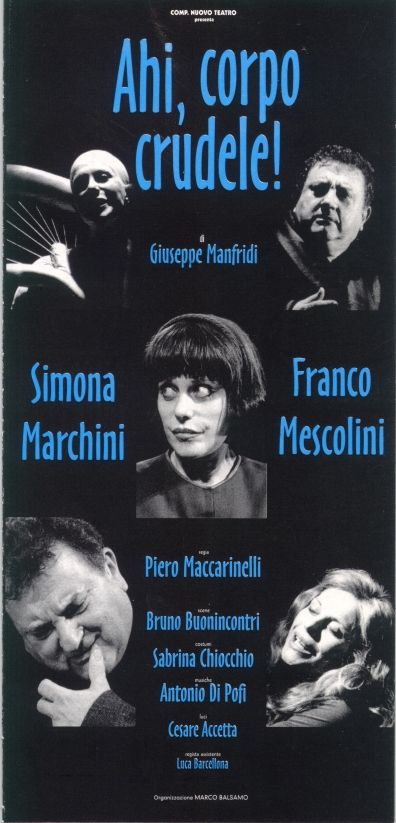

Ahi, Corpo Crudele!

Translated from the Italian. Titles, names, venues and press headlines are kept as originally published.
SIMONA MARCHINI andFRANCO MESCOLINI
in
AHI, CORPO CRUDELE!
byGIUSEPPE MANFRIDI
set design
BRUNO BUONINCONTRI
costumes
SABRINA CHIOCCHIO
music
ANTONIO DI POFI
lighting design
CESARE ACCETTA
regista assistente
LUCA BARCELLONA
directed by
PIERO MACCARINELLI
Director's notes
As a director I have worked with Giuseppe Manfridi's writing for many years, and every time I am surprised by his eclectic ability to use the Italian language in all its many facets.
Here the play tells of the loneliness and psychosomatic disorders – with their grotesque consequences – of a group of men and women who live without ever meeting in the rooms and corridors of an anonymous hotel.
The language heightens and justifies their grotesque, comic loneliness. It is a language that bends and twists into sneezes, grunts and humours. We meet a TV presenter, a chambermaid, an orchestra conductor's wife – real characters who become emblems of our shared, distorted relationship with others, denying it, suffering from it, and unleashing a torrential grand guignol of somatisations: all their contradictions, and ours.
Piero Maccarinelli
Note dell’autore
Ahi, corpo crudele! is a curious web of psychosomatic cases. Through a range of three female characters, all played by the same actress, it tells of the unpredictable developments of the conflict that can break out between an individual, man or woman, and their most unspeakable secrets.
It is said that the unconscious, when too heavily repressed, always takes its revenge, and it is often our body that pays the price, suffering the effects of such revenge in the most unexpected ways. This, at least, is what happens in the cases we tell. At times they may seem grotesque, far too funny or tragicomic, but they all rest on a basis of truth. Besides, it is not impossible that truth itself may sometimes appear tragicomic and exaggerated. These three women, whom the lead actress will play in turn, revolve around the bizarre figure of an insomniac who spends his nights in pyjamas and dressing gown in the corridor of an anonymous city hotel. The insomniac holds a secret, and it is this secret – which the conversations will lead him to reveal in an unbridled solo – that gives him his character and wraps him in unfathomable seductive powers. At first he might be mistaken for an impotent man, but he is something else entirely. The first to worry about him is a former concert pianist afflicted by a badly requited love that has left her completely hairless. To top the paradox, the unattainable object of her passion is her own husband, an orchestra conductor for whom she feels a genuine, enchanted veneration. Next, through a narrative device we will not reveal here, comes a cleaning woman: an innocent soul who never managed to see clearly within herself until one day, oppressed by inexplicable retching that forces her to carry a bucket everywhere, she realised she had absurdly somatised her revulsion for the TV news and, more generally, her television addiction. The third and last woman is the insomniac's own wife, who turns out to be the unwitting victim of a breathing disorder that, as we shall discover, is the cause of her husband's nightly torment.
From this tangle of figures the play builds a complete story, almost a kind of original 'puzzle' in which the humorous surface and the play of quick changes veil a sincere, moving and entertaining exploration of the human soul.
Giuseppe Manfridi
Photographs are free of publication rights for press use. Please always credit the photographer.
Failed to get data. Error:
Request had insufficient authentication scopes.