
Delitto/castigo

Translated from the Italian. Titles, names, venues and press headlines are kept as originally published.
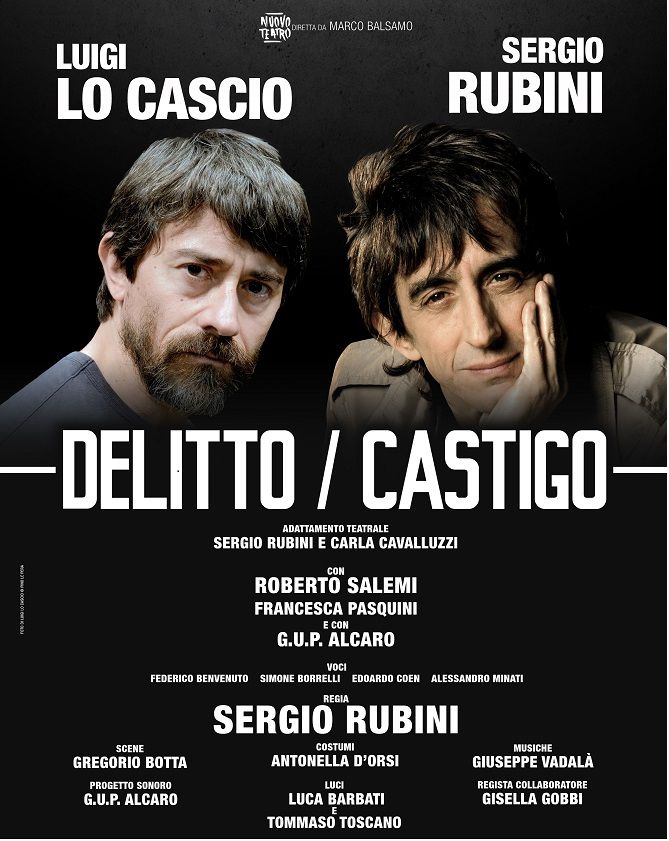
LUIGI LO CASCIO SERGIO RUBINI
in
DELITTO/CASTIGO
adattamento teatrale by SERGIO RUBINI – CARLA CAVALLUZZI
with
ROBERTO SALEMI
FRANCESCA PASQUINI
and with
G.U.P. ALCARO
voices
FEDERICO BENVENUTO
SIMONE BORRELLI
EDOARDO COEN
ALESSANDRO MINATI
set design
GREGORIO BOTTA
costumes
ANTONELLA D’ORSI
music
GIUSEPPE VADALÁ
progetto sonoro
G.U.P. ALCARO
lighting design
LUCA BARBATI – TOMMASO TOSCANO
production photos
SERENA PEA
regista collaboratore
GISELLA GOBBI
directed by
SERGIO RUBINI
Lo spettacolo ha debuttato to Teatro Salieri by Legnago on 20 February 2018.
Vertigo and unease accompany the reader of Crime and Punishment: the vertigo of finding oneself inside the obsession of a voice that sees in murder its one and only assertion of existence. Crime, then, as the mirror of one's own limit and a horizon that must be crossed for self-affirmation. A conflict that creates a fever, a split, a doubling; a murder that produces a punishment – a double-edged sword. Like the writing of the novel itself, where reality, told in the third person, is constantly interrupted and assailed by the first-person voice of the protagonist's thoughts. And it is precisely this two-toned nature of Crime and Punishment that suggests bringing it to the stage as a reading for two voices. Sergio Rubini and Luigi Lo Cascio are the two voices of the work, drawing the audience into the story and making them live the protagonist's obsession first-hand.
TRAMA
Crime and Punishment, Dostoevsky's most widely read and best-known work, tells of the torment of Rodion Romanovich Raskolnikov, a desperately poor young man choked by debt, who kills a mean old moneylender. The novel clearly shows the protagonist's inner conflict, which splits him in two. We live through his lucid reasoning as he refuses to feel remorse, to prove to himself that he belongs to the category of those he calls 'Napoleonic' – great men, superior minds with revolutionary ideas, entitled to live and act above the common law because all their actions, even those condemned by morality, ultimately aim at the collective good. He tries to convince himself that the murder of the old moneylender, having freed many poor debtors from her yoke and removed an evil being from the face of the earth, is not only blameless and should cause him no repentance, but is the very proof that he belongs to a superior category. On the other hand, we witness the slow dawning in him of the awareness that he cannot escape guilt and the terror of being found out: in the end he must resign himself to being not a great man at all, but a 'louse', and as such to deserving punishment.
Articoli
Photographs are free of publication rights for press use. Please always credit the photographer: ph. Serena Pea Failed to get data. Error:
Request had insufficient authentication scopes.Tournée season 2017-2018
Teatro Salieri Legnago 20/02/2018
Teatro Toniolo Mestre 21–25/02/2018
Teatro Bellini Napoli from 28/02 to 04/03/2018
Teatro Civico La Spezia 06–07/03/2018
Teatro Sociale Mantova 08/03/2018
Teatro Comunale Treviso 09–11/03/2018
Teatro Nuovo Verona 13–18/03/2018
Teatro Comunale Thiene 20–22/03/2018
Teatro della Pergola Firenze 23–29/03/2018
Teatro Tondelli Riccione 03/04/2018
Teatro Ambra Jovinelli Roma 05–15/04/2018
Teatro Petruzzelli Bari 17–18/04/2018
Teatro Comunale Corato 19/04/2018
Teatro Nuovo Verdi Brindisi 20/04/2018
Teatro Giordano Foggia 21–22/04/2018
Teatro Mercadante Cerignola 23/04/2018
Teatro Orfeo Taranto 24–25/04/2018
Teatro Comunale Caserta 27–29/04/2018
Tournée season 2018-2019
Teatro Sociale Como 19–20/01/2019
Teatro by Bellinzona 22–23/01/2019
Teatro Duse Bologna 25–27/01/2019
Auditorium Unical Rende 29–30/01/2019
Teatro Vittorio Emanuele Messina from 01 to 03/02/2019
Teatro Creberg Bergamo 07–10/02/2019
Teatro Zandonai Rovereto 12–13/02/2019
Teatro Alfieri Torino 15–16/02/2019
Teatro Franco Parenti Milano 19–24/02/2019