
Il Dio della Carneficina
Translated from the Italian. Titles, names, venues and press headlines are kept as originally published.
IL DIO DELLA CARNEFICINA
byYASMINA REZA
translationALESSANDRA SERRA
with (in o.a.)
ANNA BONAIUTO
ALESSIO BONI
MICHELA CESCON
SILVIO ORLANDO
scene, costumi, luci
GIANNI CARLUCCIO
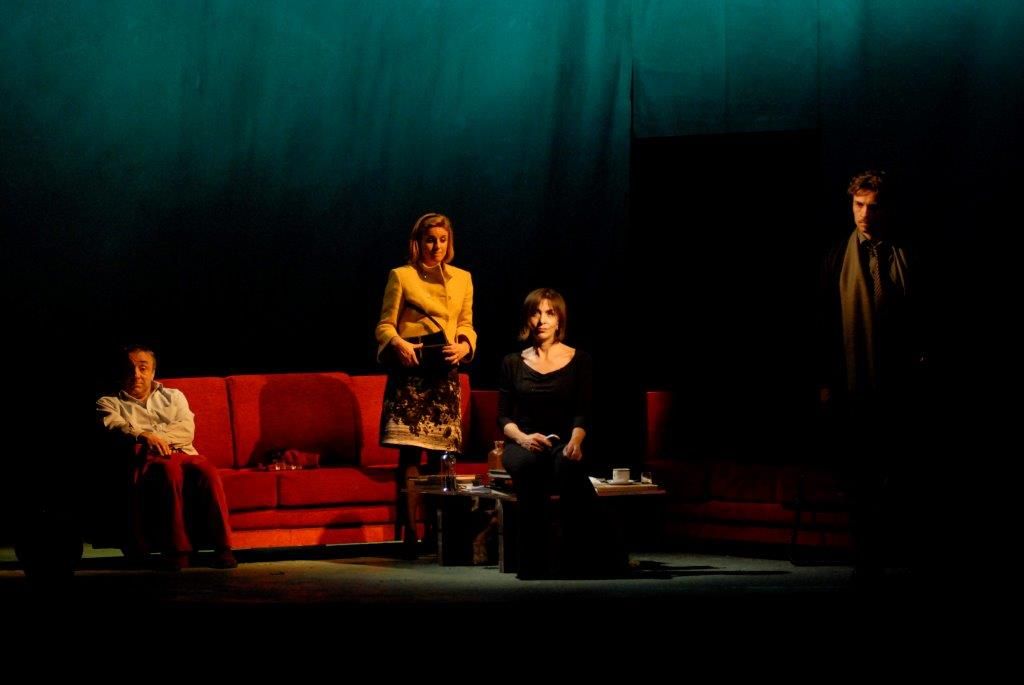
production photos
ORESTE LANZETTA
directed by
ROBERTO ANDÒ
The show premiered at the Teatro Ventidio Basso in Ascoli Piceno on 6 January 2009. Véronique and Michel Houillé, parents of little Bruno, receive at home Annette and Alain Reille, parents of Ferdinand, who hit their son in the face with a bamboo stick in a public park. The two couples have decided to meet to settle 'the matter' in a civilised way.
At first all the characters are benevolent and conciliatory towards one another; they even try to talk about the need for tolerance – talk that gradually becomes infected and turns into something else entirely.
Una straordinaria commedia with un cast d’eccellenza.
In Yasmina Reza's God of Carnage there is a kind of furious sarcastic humour, but also the finely chiselled craft of a dialogue poised between comedy and tragedy, recreated by listening to the deadly, terrible power of middle-class speech – the irresistibly chameleon-like music and phraseology of the middle ground and its vast, sublime galaxies. A little moral treatise on the theory of culture, which seems to want to answer – with the ambiguity typical of theatre – the following question: will good intentions save us?
Reza seems to have no doubts, and her play gives the audience an answer that is, in its way, peremptory: no! But the unequivocal scepticism of this answer serves an implacable machine, virtuosically varied on the edge of an epochal abyss, between solidarity and selfishness.
It is a text to be staged trying not to be too infected by the sulphurous cynicism that inhabits it, letting oneself be guided by the precise, geometric sequence of twists, by the skill with which the dialogue opens new, unexpected perspectives that shade and shift, in turn, through the four characters who hold its weave together: hatred, resentment, envy, emptiness, nothingness.
Reza does not believe in the 'magnificent and progressive destiny' of contemporary man – well informed, a diligent servant of generic moral causes, compulsively seeking improbable certificates of civility and good manners for himself. She thus manages to unearth the barbaric, nihilistic undercurrent of this humanity, meanly incapable of sharing even the smallest common project. She does so within the modest perimeter of an intelligent divertissement, a contagiously funny entertainment whose laughter also swamps the audience, reflected in the distorting mirror of a condition in which many will recognise themselves.
I had never tackled a text of this kind before, probably out of suspicion. I was wary of the excessive definition the characters carry, of the excessive programmatic quality that usually inhabits this kind of playwriting about the present. Theatre has always seemed to me inextricably bound to the dizzying possibility of shaking our certainties, leading us into unknown places through a language whose meaning we never fully grasp. Seeing a performance in Paris of the production directed by Reza herself, with a formidable quartet of actors including an extraordinary Isabelle Huppert, I understood that this text contains a challenge, lying between the apparent obviousness of what it shows and the mysterious savagery it hides. It is a challenge I could not even attempt without the complicity of performers able to wrestle with the text, opening up its ferocity and the ineffable undercurrent that is its special hidden energy, its dark and disorienting humus.
I decided to stage God of Carnage to accept this challenge, sharing it with four actors – Anna Bonaiuto, Alessio Boni, Michela Cescon and Silvio Orlando – who, with their exceptional personalities, give me, even before we begin, the safe-conduct this journey needs and the comforting certainty that, in any case, it will have been worth it.
Roberto Andò
Articles. Photographs are free of publication rights for press use. Please always credit the photographer: ph. Pino Le Pera
Failed to get data. Error:
Request had insufficient authentication scopes.Tournée season teatrale 2008-2009
Teatro Ventidio Basso Ascoli Piceno 06–08/01/2009
Teatro Manzoni Pistoia 09–11/01/2009
Teatro Caio Melisso Spoleto (PG) 13/01/2009
Teatro Morlacchi Perugia 14–18/01/2009
Teatro Donizetti Bergamo 20–25/01/2009
Teatro Franco Parenti Milano from 27/01 to 08/02/2009
Teatro Argentina Roma 10–22/02/2009
Teatro Comunale dei Rozzi Siena 24–26/02/2009
Teatro Guglielmi Massa Carrara from 27/02 to 01/03/2009
Teatro Asioli Correggio (RE) 03–04/03/2009
Teatro Dante Alighieri Ravenna 05–08/03/2009
Teatro Salieri Legnago (VR) 10–11/03/2009
Teatro Comunale Ferrara 12–15/03/2009
Teatro Sociale Cittadella (PD) 17/03/2009
Teatro Toniolo Mestre (VE) 18–22/03/2009
Teatro Comunale Thiene (VI) 24–26/03/2009
Teatro Comunale Mario Del Monaco Treviso 27–29/01/2010
Teatro Verdi Salerno from 31/03 to 05/04/2009
Teatro Bonci Cesena 07–10/04/2009
Teatro Lauro Rossi Macerata 14–15/04/2009
Teatro delle Muse Ancona 16–19/04/2009
Teatro della Fortuna Fano (PU) 21–23/04/2009
Teatro Curci Barletta 24–26/04/2009
Tournée season teatrale 2009-2010
Teatro Traiano Civitavecchia 11/12/2009
Teatro Eliseo Roma from 15/12/2009 to 10/01/2010
Teatro Chiabrera Savona 12–14/01/2010
Teatro Cagnoni Vigevano 15–17/01/2010
Teatro San Rocco Seregno 19–21/01/2010
Teatro del Giglio Lucca 22–24/01/2010
Teatro Dante Carlo Monni Campi Bisenzio (FI) 26–27/01/2010
Teatro Comunale Carpi 28–31/01/2010
Teatro dell’Osservanza Imola (BO) 02–07/02/2010
Teatro Politeama il Rossetti Trieste 09–14/02/2010
Teatro della Regina Cattolica (RN) 16–17/02/2010
Teatro Storchi Modena 18–21/02/2010
Teatro Traiano Civitavecchia 26–27/02/2010