
Io Sarah, Io Tosca
Translated from the Italian. Titles, names, venues and press headlines are kept as originally published.
LAURA MORANTE
in
IO SARAH, IO TOSCA
byLAURA MORANTE
and with
CHIARA CATALANO
voce e pianoforte
set designLUIGI FERRIGNO
costumesAGATA CANNIZZARO
original musicMIMOSA CAMPIRONI
lighting designTOMMASO TOSCANO
directed byDANIELE COSTANTINI
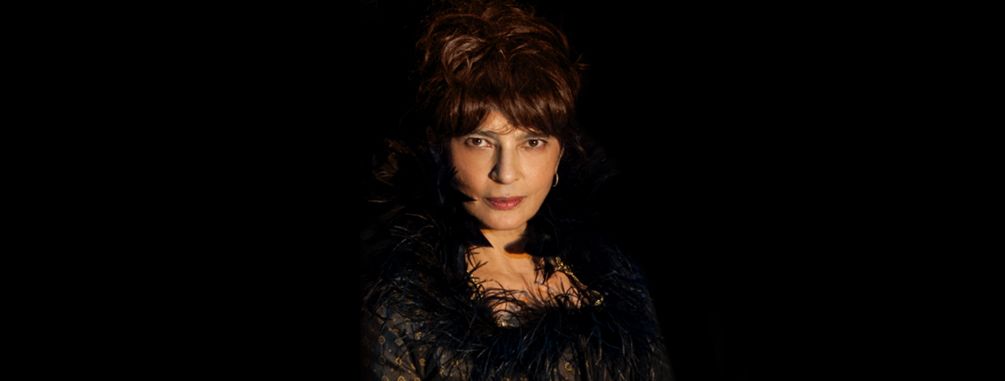
The photo of Laura Morante is by Ada Masella. AUTHOR'S NOTES
A little over a year ago Mimosa Campironi suggested I read a short melologue inspired by Sarah Bernhardt and her relationship with Victorien Sardou and with the character of Tosca, which the playwright had written for her. We were in the middle of the pandemic; theatres were said to be reopening, though without being able to fill the house. So I was looking for a text for a production that would be easy to stage, with no more than two actors. That short reading hinted at an unusual and fascinating personality. Having lived in France for many years, I had often heard of Sarah Bernhardt – adored by Oscar Wilde, admired by Proust and by a very young Sigmund Freud, who devoted a page of his diary to her, the favourite of Victor Hugo, and cordially detested by Anton Chekhov. It has been written of Bernhardt that she was the last actress of the nineteenth century, as opposed to Eleonora Duse, who was called the first actress of the last century. In French theatre circles anecdotes are told about her extravagant whims, such as surrounding herself, in the middle of Paris, with exotic and even dangerous animals – monkeys, parrots, cheetahs, even alligators! – some of her particularly caustic remarks are quoted, and people recall how she insisted on performing even after her leg was amputated at the age of seventy-one: carried on stage on a gilded litter, she even undertook a last adventurous and exhausting American tour. But of the person behind the appearance, the history and the legend of what was perhaps the first true diva – who managed to get newspapers around the world talking about her almost daily – of the woman Sarah Bernhardt was, I knew almost nothing. Perhaps it was worth getting to know her. So I set out on a fascinating journey through the many books devoted to her, starting with her autobiography, as revealing of her character as it is imprecise, elusive and full of gaps regarding the not always edifying events that made her a famous actress and woman – idolised and harshly criticised, but always at the centre of the stage – and above all regarding her private and romantic life: suffice it to say that her son Maurice first appears in Bernhardt's memoirs when he is already four, and nothing is said about who his father might have been. So the investigation had to go on: the interesting biography by Arthur Gold and Robert Fizdale, the books by Claudette Joannis and Guy De Pierrefeux, and the records of the libel suit Sarah brought – after wrecking her house – against her former colleague and friend Marie Colombier, author of a bestseller of the day that revealed the Diva's secrets. The further I went in my exploration, the more convinced I became that the encounter between Sarah and Tosca – through the largely mysterious and unconscious dialogue that always arises between a character and the actor who plays it – could bring about a gradual and fascinating unveiling of Sarah's own personality: jealousy, passion, rage, devotion and rebellion belonged not only to the fiction of Sardou's drama but also to its first masterly interpreter. At the end of the journey I felt I was finally entitled to try to tell Sarah's story: cynical and sentimental, unscrupulous and dreamy, superstitious and fearless, vulnerable and combative, as jealous of her privacy as she was insatiably hungry for fame and, perhaps above all, for love.
Laura Morante
Director's notes
Victorien Sardou's “La Tosca” was first performed on 24 November 1887 in Paris, at the Théâtre de la Porte Saint-Martin. Sardou had written the drama for the most important actress of the time, the celebrated Sarah Bernhardt. On their third show together, after “Fedora” and “Théodora”, the author and the great actress were the two 'stars' of the French stage. Someone might ask who the director was: the answer is that his name was not on the bill. The figure of the director as we came to know it during the twentieth century did not yet exist. Directing served as a link and a mediation between the needs of the authors and those of the actors. This role, with no official recognition, was carried out by the authors themselves, by theatre managers, or sometimes by one of the actors. The task and identity of the stage director began to come to the fore in the last years of the nineteenth century, thanks to the ideas and work of a few new actor-directors, to the point of giving rise to a decisive theatrical reform.
It is curious that in that same year, 1887, André Antoine, a 29-year-old French actor-director, founded the “Théâtre Libre” in Paris, and in Moscow Konstantin Stanislavski, aged just 24, made his debut as actor-director at the theatre of the Moscow Society of Art and Literature. So in 1887, while Bernhardt triumphed in Sardou's “La Tosca”, the first two great directors to herald modern theatre were making their debuts in Paris itself and in Moscow.
Antoine's company disbanded in 1896, while in 1898 Stanislavski and Vladimir Nemirovich-Danchenko founded the Moscow Art Theatre, which would become famous for its productions of Anton Chekhov's “The Seagull”, “Uncle Vanya” and “Three Sisters”.
It is in this context that Sarah Bernhardt and Victorien Sardou staged “La Tosca” – a very lively context, heralding great changes and extraordinary innovations in the art of theatre.
Laura Morante's “Io Sarah, Io Tosca” portrays Sarah Bernhardt in the days before the premiere of “La Tosca”. The play is built in three scenes: the first on 3 November 1887, at the start of rehearsals; the second two weeks later; the third at dawn on 24 November, the day of the opening. It shows Sarah mastering first-night nerves, preparing to face her enemies and reliving her past along a path that is emotional rather than chronological.
In our show, on stage are Sarah and a young musician who interacts, comments and converses only through the sound of her piano and her singing, in a continuous flow of acting, action and music that I hope is gripping, moving and at times even funny.
Daniele Costantini
Photographs are free of publication rights for press use. Please always credit the photographer: ph. Ada Masella – Filippo Manzini
Failed to get data. Error:
Request had insufficient authentication scopes.
Articoli
Salta mesiCorrente mese genfebmaraprmaggiulugagosetottnovdicott, 2026
Nessun Evento
Tournée stagione 2021-2022Teatro Comunale Caserta 29–31/10/2021
Teatro Comunale Carpi 05–07/11/2021
Teatro della Pergola Firenze 09–14/11/2021
Teatro Ambra Jovinelli Roma 16–28/11/2021
Teatro Comunale Thiene from 30/11 to 01/12/2021
Teatro Era Pontedera 04–05/12/2021
Teatro Toniolo Mestre 10–19/12/2021
Teatro Sociale Camogli on 09/01/2022
Teatro Chiabrera Savona l’11/01/2022
Teatro Nuovo Verona 25–30/01/2022
Teatro Partenio Avellino from 01 to 02/02/2022
Teatro Verdi Salerno 03–06/02/2022