
Irma la Dolce
Translated from the Italian. Titles, names, venues and press headlines are kept as originally published.
IRMA LA DOLCE
commedia musicale by Alexandre Breffort
music diMarguerite MonnotandRaymond Legrand
orchestrazione Gérard Daguerre
epilogo Jérôme Savary
translationLuigi Lunari
with
Stefania Rocca
Fabio De Luigi
and with
Fulvio Falzarano – Ugo Conti – Luis Molteni
Giorgio Li Bassi – Matteo Brigida – Mino Manni
Vito Facciolla – Roberto Salemi – Cesare Vangeli
Emanuele Fortunati – Sax Nicosia
Daniela Ayala – Natalia Cretella
Franco Coni fisarmonica
Vincenzo Caruso piano
Luigi Sigillo contrabbasso
Luigi Fiscale batteria
Gianluca Mirra percussioni
collaborazione artistica
Léonidas Strapatsakis
set design
Jean-Marc Stehlé
costumes
Michel Dussarrat
lighting design
Luigi Ascione
choreography
Cesare Vangeli
sound design
Gianluca Tilesi
directed by
Jérôme Savary
Irma is something quite different from a pleasant little musical comedy. It is a formidable text – it is no accident that Peter Brook staged it in his day.
With Gérard Daguerre, my accomplice on “La Périchole”, who wrote the arrangements, we wanted to stage a truly simple Irma, as it was written, far from the Broadway version: an Irma of the Pont Caulaincourt, an Irma in the spirit of Breffort, tender poet of the suburbs, and of Monnot, the heart-rending composer of Piaf's finest songs.
No grand musical effects, but a small orchestra (the one from my latest shows) led by maestro Gérard at the piano and strengthened by the accordion prodigy Roland Romanelli.
No grand ballets, no special effects: the story alone is enough.
A tender spotlight on a couple who, in my view, equal the great lovers of the repertoire. Curiously, this story of a beautiful girl searching for ideal love is incredibly modest. And it raises the eternal problem of a woman seeking her independence in a society still stuck in the 1950s.
In a world where children and young people are bombarded by permissiveness in every direction and by sex served up in every form, Irma la Douce takes on the dimension of a moral tale. I certainly did not try to make it a fairy tale. In Irma's time, as today, boys are boys, and the underworld is no less sinister than it is now. But Alexandre Breffort and Marguerite Monnot, with their tenderness, take us beyond the everyday into a world of dreams and emotion.
Jérôme Savary
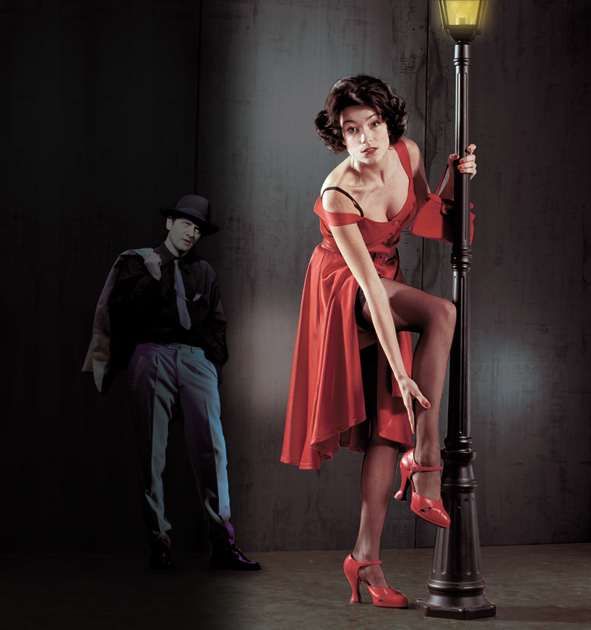
The work: More than a simple musical comedy, Irma la Douce by Alexandre Breffort, with music by Marguerite Monnot and Raymond Legrand, stages the love between a policeman and a Paris prostitute, with a live orchestra, choreography and music blending together in a truly engaging story. The plot: the small-time crook “Gaston the Wreck” falls in love with a prostitute called Irma, known as 'la douce'; consumed by jealousy, he devises a series of disguises to become her only client and win her love in return. Irma la Douce is a world whose characters naively believe nothing bad can happen to them as long as they escape the police; Irma and Gaston are more innocent still, believing that love alone will solve everything – but it is precisely when they begin to love each other that the trouble starts… the drama of jealousy looms…
Its success: first performed in Paris in 1956, Irma la Douce was an immediate and lasting success that turned the play into an international phenomenon, travelling from Europe to Broadway and Hollywood (with the film version directed by Billy Wilder, starring Jack Lemmon and Shirley MacLaine in masterly performances).
The audience: an ironic, satirical and moral work, it avoids vulgarity in treating a delicate subject such as prostitution, in a story where cynicism and romance constantly coexist. A delightful comedy that over the years has always won the approval of critics and of a discerning audience: Irma la Douce is an original and entertaining show appreciated by mature audiences – it pleases critical and fashionable Parisian audiences and demanding London ones, and its story wins over admirers of the great Hollywood hits.
Photographs are free of publication rights for press use. Please always credit the photographer: ph. Oreste Lanzetta
Failed to get data. Error:
Request had insufficient authentication scopes.Tournée season 2002-2003
Teatro Civico La Spezia 22–23/10/2002
Teatro Ventaglio Nazionale Milano from 29/10 to 30/11/2002
Teatro Verdi Salerno 03–08/12/2002
Teatro Saschall Firenze 12–15/12/2002
Teatro Novelli Rimini 17–19/12/2002
Teatro Manzoni Pistoia 20–22/12/2002
Teatro delle Celebrazioni Bologna 08–12/01/2003
Teatro Colosseo Torino 14–18/01/2003
