
La Partitella
Translated from the Italian. Titles, names, venues and press headlines are kept as originally published.
LA PARTITELLA
byGIUSEPPE MANFRIDI
with (interpreti e personaggi)
VITO DI BELLA Alex
BRUNO GAMBAROTTA Bruno Gambarotta
FEDERICO MARRAS Carlo
ANDREA GIULIANO Enrico
ANDREA DE MANINCOR Er Verona – Giussani
CHIARA TANGO Flavia
BENIAMINO ONORATO Furio
CARLA FERRARO Gianna
PAOLA CAMPOSARCONE La Ruvida
CLAUDIO PALLOTTINI Macioci
GALA ZOPPI Mara
ALESSANDRO TIBERI Massimiliano
PAOLA MACCARIO Melania
CLOTILDE CLOVER Nadia
GABRIELE LINARI Osvaldo
USA TORRI Pia
BED CERCHIAI Rashid
MADDALENA RECINO Rita
FULVIA LORENZETTI Sissi
ANDREA PIROLLI Stefano
directed by
PIERO MACCARINELLI
in collaboration with la RAI di Torino – RAIDUE PALCOSCENICO
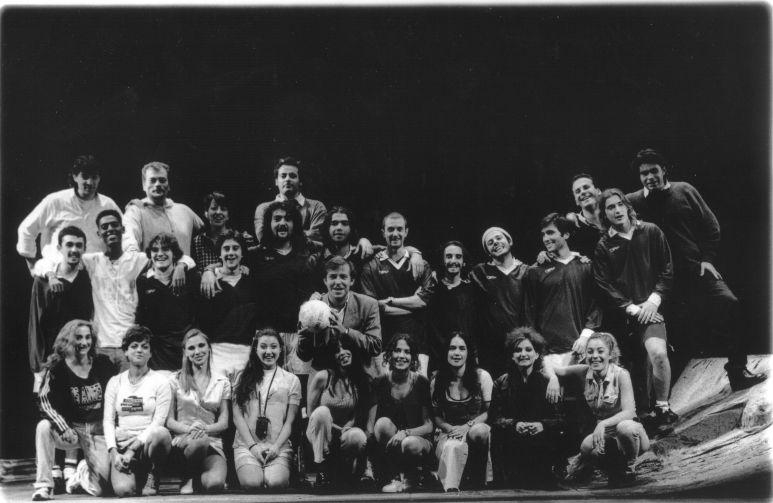
Broadcast on 10/05/1997 on Rai Palcoscenico. A patch of dirt at the foot of an embankment crossed by a flyover. On the lumpy ground facing the pitch beyond the pillars, just two concrete blocks left by the workmen, which will serve as a viewing bench for the girls. From the first light of dawn, boys and girls skipping school gather in this free zone, this no man's land, for a kickabout in which the boys will play and the girls will watch. The situation, only loosely tied to the football, allows a web of stories to unfold: small great loves, the anxieties of growing up, dreams of future triumphs, marriage plans and all that can feed the imagination at that ineffable age of transition between the last year of school and the first of university or work. The second act tells of another match played on the same pitch by the same young people, but a year earlier. This 'backwards' structure lets us piece together the inscrutable designs of fate, which, as it turns out, has played – as so often – with these young lives, deciding them at its pleasure and in deference to an apparent randomness of which it makes no sense to reveal anything here. Language plays an important role in this play. The young people speak in a clearly Roman idiom, but it would be a mistake to see it as simply a dialect. Rather, it is a 'free zone' in which the most different social strata and the most distant cultural backgrounds can meet. In that odd human assembly – the microcosm that gathers in such circumstances – it is not unusual to find the graduate next to the illiterate, the fifteen-year-old next to the thirty-year-old. A promiscuity also reflected in the harlequin-like football kits, which it is pure illusion to hope might ever achieve an agreed uniformity. Perhaps these were also the reasons why Pasolini, an excellent footballer, found in the very idea of the 'kickabout' – of which he was a passionate supporter and frequent player – traits of poignant, childlike and melancholy poetry.
Director's notes
Eleven boys and nine girls – twenty people who have not yet entered working life, who have not yet become adults – meet as on other occasions, a year before and a year after, on a patch of dirt under a flyover overlooking an improbable little football pitch. The boys, eleven on stage, hardly ever manage to be eleven on the pitch too. The action takes place in two halves: a year later and a year earlier. There is no present. The language is a kind of lowest common denominator of Roman dialect. We are in Rome, but not all the boys and girls are Roman. Apart from the core group of six inseparable friends, the girls are not all the same as the year before. A year later there are three new love stories. A year earlier, two relationships are about to crack. Some are single a year earlier and still single a year later. One, a year later, is dead, run over on a zebra crossing. A year earlier it was hot. A year later it is cold. A year earlier the pitch looked like a duck pond; it still does a year later, though the heat has dried it a little. A year earlier the girls listened to Zucchero, a year later to Jovanotti. A year earlier some of them hoped for a great future. A year later the great future is behind them. Theatre is – or at least for me it is – communication, and my task is to make Giuseppe Manfridi's language as communicative as possible: a group language, layered, other, kneaded from syntactic rules chewed over in an everyday code designed precisely for communication between members of the group. A group chosen in this case out of both affinity and despair, in the illusory hope of thus withstanding the blows of the world, and that span of time between a year before and a year after that will push the group to face a tomorrow before which even the best-equipped adults find themselves wrong-footed and unprepared. And what seems to matter most in the two time frames are the absences and the chances: absences of spaces (the football pitch) or of people (Pascucci). I have deliberately named the only absent one, Pascucci, who precisely through chance and in an absent space (the pitch) will find a possible way out for his future.
Piero Maccarinelli
Note dell’autore
The Roman dialect of La partitella is the most anomalous of dialects – let's say it is the least dialect of all dialects. A language with no history, no depth, unable to return ancient sounds or ancient memories. It is a language open to a thousand raids: the latest anglicisms, northernisms, youth slang, distortions born of wordplay (anagrams, shifts of meaning, and so on). A way of speaking, in short, that is a kind of urban Esperanto that can change from one day to the next with the arrival of new myths and the swift obsolescence of others, shaped on a blurred idiomatic model that is precisely the most porous and permeable Roman. In some ways also the one most understandable to any Italian ear, precisely because of its wide circulation across the country through cinema and television, which have made this linguistic 'pastiche' a common reference across all groups. Above all, then, a language that does not stand still; a mirror of uncertain generations anxious to define themselves and their own destiny. If the word were not all too suggestive of a social affliction of ours, I would say: their own place.
Certainly, years ago, this language allowed me to form the sentences, the speeches and the ideologies of my adolescence: it is the language of those distant ambitions.
Giuseppe Manfridi
