
Misantropo
Translated from the Italian. Titles, names, venues and press headlines are kept as originally published.
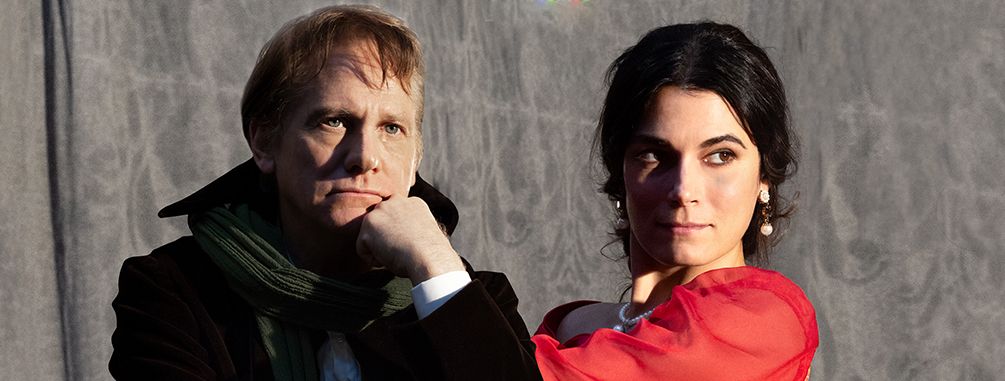
GIULIO SCARPATI
VALERIA SOLARINO
in
MISANTROPO
by Molière traduzione by Cesare Garboli
with
BLAS ROCA REY
ANNA FERRAIOLI
MATTEO CIRILLO
FEDERICA ZACCHIA
MAURO LAMANNA
MATTEO CECCHI
set design
LUIGI FERRIGNO
costumes
MARIANNA CARBONE
lighting design
RAFFAELE PERIN
music
MARCO SCHIAVONI
directed by
NORA VENTURINI
Director's notes
“The Misanthrope is the story of a man who wants to have a decisive meeting with the woman he loves and who, at the end of a whole day, still hasn't managed it.” The words with which Louis Jouvet, a great man of the theatre, summed up Molière's masterpiece made me smile, when I first read them, for their obvious irony. In fact they capture an important element of the work, often overlooked in favour of the political theme of the honest, sincere man fighting the corruption and hypocrisy of society. In this masterpiece, always poised between comedy and tragedy, the private side of the lover's torment is theatrically as interesting as the social one, because it brings out the human factor and keeps it relevant centuries later. In his urgency to have it out with Célimène, who eludes him and avoids confrontation, and to sweep away all ambiguity, Alceste is an extremely modern character, contradictory to the point of paroxysm. A cerebral, indignant man, a kind of anchorite for whom Good and Ethics are absolute choices that admit not the slightest compromise, claimed with fury in the scene of the quarrel with his friend Philinte – which I wanted downstage, in close contact with the audience, almost a prologue to the show. But Alceste is at the same time a deeply passionate, carnal man, a masochist ruled by a tyrannical and insatiable desire for a woman who is his opposite in everything: world view, lifestyle, idea of human relations. Alceste is a man like us: he is indignant about what he desires, he suffers in mind and flesh, moving in a society where appearance prevails over values. The same goes for Célimène, queen of the salons, surrounded by her fashionable court, who will give up nothing – neither Alceste's exclusive love nor the game of seduction with a crowd of suitors. Their very incompatibility is the spring that drives them towards each other. Tragic and comic together, Alceste and Célimène are our contemporaries as a romantically impossible couple: they don't understand each other but they love each other, they flee each other but seek each other out, they detest each other yet struggle to part. They are a man and a woman of today, with rights and wrongs equally shared, stubborn in refusing to give in to the other's demands, tenaciously attached to their own life choices, in perpetual conflict. Alceste and Célimène are the protagonists of a bitter comedy with no happy ending. Around them moves a carousel of human types: the politician with literary pretensions, the vain, fashionable young things, the hypocritical, sanctimonious lady of charity – highly topical parodies of the vices and flaws of high society yesterday, today and tomorrow. In their flaws we can find and recognise ourselves, and laugh as we look in the mirror. And a large mirror looms over the stage, Célimène's little salon-theatre, behind whose curtains we glimpse the company preparing for the performance. In the show the contemporary world bursts into classical antiquity, reality into fiction, and the audience can see reflected in the ancient surface the impulses and idiosyncrasies they experience every day. Nora Venturini
Personaggi in o.e. Interpreti
FILINTO BLAS ROCA REY
ALCESTE GIULIO SCARPATI
ORONTE, BASCO, DU BOIS MATTEO CIRILLO
CELIMENE VALERIA SOLARINO
ELIANTE FEDERICA ZACCHIA
CLITANDRO MATTEO CECCHI
ACASTE MAURO LAMANNA
ARSINOÈ ANNA FERRAIOLI
Photographs are free of publication rights for press use. Please always credit the photographer.