
Santos
Translated from the Italian. Titles, names, venues and press headlines are kept as originally published.
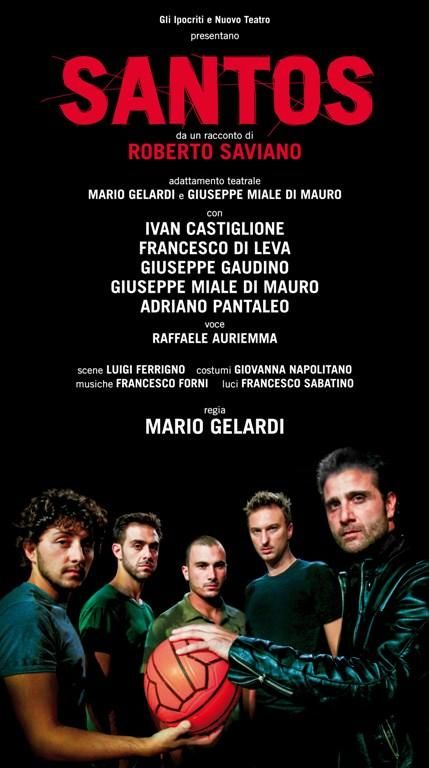
SANTOS
da un racconto by ROBERTO SAVIANO
adattamento teatrale MARIO GELARDIandGIUSEPPE MIALE DI MAURO
with
IVAN CASTIGLIONE
FRANCESCO DI LEVA
GIUSEPPE GAUDINO
GIUSEPPE MIALE DI MAURO
ADRIANO PANTALEO
voice
RAFFAELE AURIEMMA
set design
LUIGI FERRIGNO
costumes
GIOVANNA NAPOLITANO
music
FRANCESCO FORNI
lighting design
FRANCESCO SABATINO
directed by
MARIO GELARDI
Santos is a short story by Roberto Saviano, published in a collection but practically unknown.
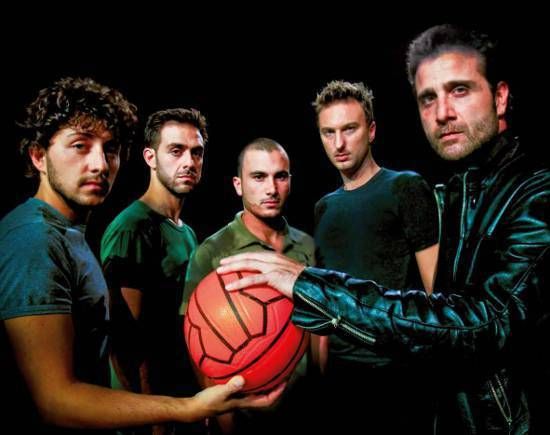
It is the story of four boys recruited as Camorra lookouts. Their job is to play five-a-side football in a square and give warning when the police or anyone suspicious arrives. Saviano follows the boys' path as they find themselves choosing between football and crime.
The game as a metaphor for life; football as the only way out of a life that seems miserable.
The boys have to choose which side they are on: keep making easy money through activities that become ever more criminal, or give it all up and try to make their dreams come true.
Santos is set in Naples, but it is not necessarily a Neapolitan story. Saviano describes the lives of four boys, of a young boss on the rise and of an old clan leader, but he also describes a small world that could be any town square.
Santos – the title comes from the orange ball the boys play with – is a story full of emotions and events, written in the strong, dynamic style typical of Saviano.
We were particularly struck by the story of one of the boys who, out of passion for football – for the thrill of carrying on a move during a match – is thrown out of the group, and precisely because of this is saved from a life of hustling and crime.
Note d’autore
I have always believed that a chance of salvation can exist anywhere, in every life. I always thought so, but I became certain of it when I met Lionel Messi, the Argentine striker, or when I followed the training of the boxers of Marcianise before they went to the Olympics. Southern Italy and Argentina are two difficult lands where sport is an opportunity that goes far beyond the dream of a better life. I wrote Santos thinking of the boys in my city who play football in the street. Every square, every open space, every corner becomes an improvised pitch for them, a stadium for passers-by. The boys who play in the most deprived neighbourhoods, in the outskirts I have so often described, often do not look to the future with optimism; sometimes they don't even think they have a future, trapped as they are in a land that has so little to offer. But in Santos there is something different: hope becomes a real chance of salvation, and following your passion – scoring that goal – can save your life. The boys in Santos leave no stone unturned; they try to make their dream come true, because, as Maradona said, “Only those who have the courage to take penalties miss them.”
For me – and for those who worked on it with me, Mario Gelardi, Giuseppe Miale di Mauro and Ivan Castiglione – Santos is the light at the end of a long, dark tunnel. Santos is a simple joy: the joy of a game of football in the street when you were small. And now that I no longer play football in the street, I like to relive those moments and give back their childish lightness, the irrational conviction that one day things can change, and not just for ourselves. I like to think that my land, despite everything, still has something to offer.
Roberto Saviano