
Sogno di una Notte di Mezza Estate
Translated from the Italian. Titles, names, venues and press headlines are kept as originally published.
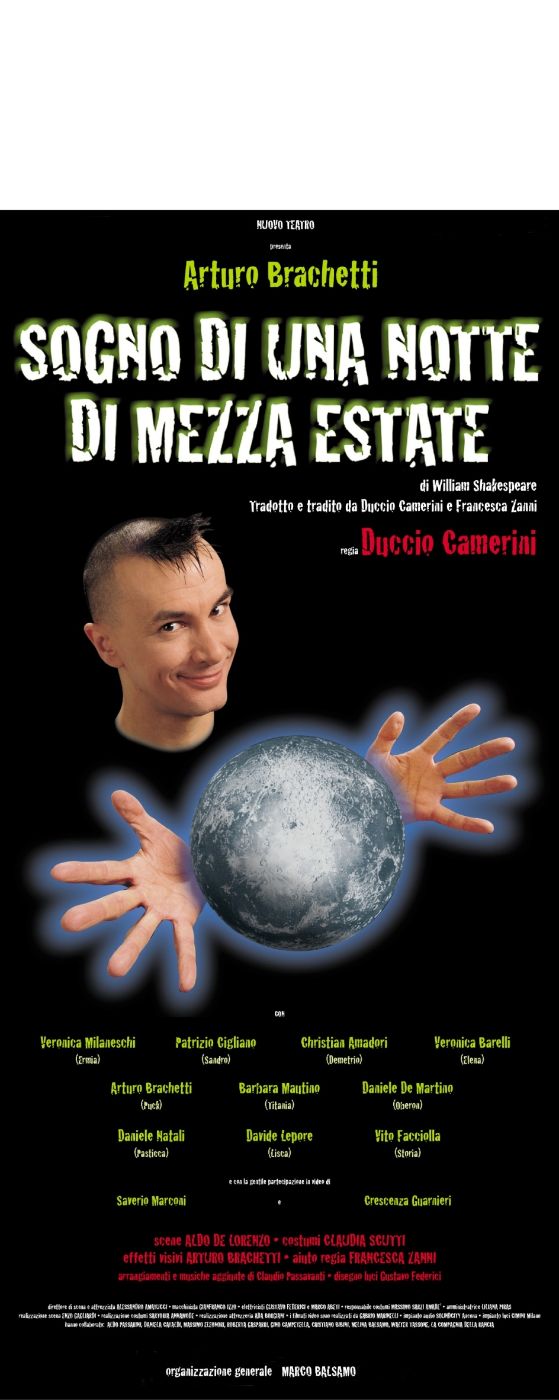
ARTURO BRACHETTI
in
SOGNO DI UNA NOTTE DI MEZZA ESTATE
byWILLIAM SHAKESPEARE
tradotto e tradito da DUCCIO CAMERINIandFRANCESCA ZANNI
with
VERONICA MILANESCHI Erminia
PATRIZIO CIGLIANO Sandro
CHRISTIANO AMADORI Demetrio
VERONICA BARELLI Elena
BARBARA MAUTINO Titania
DANIELE DE MARTINO Oberon
DANIELE NATALI Pasticca
DAVIDE LEPORE Lisca
VITO FACCIOLLA Storia
and with la gentile partecipazione in video by
SAVERIO MARCONI and CRESCENZA GUARNIERI
set design
ALDO DE LORENZO
costumes
CLAUDIA SCUTTI
effetti visivi
ARTURO BRACHETTI
assistant director
FRANCESCA ZANNI
arrangiamenti e musiche aggiunte by
CLAUDIO PASSAVANTI
lighting design
GUSTAVO FEDERICI
coreografie originali
DANIELA CATALDI
directed by
DUCCIO CAMERINI
Lo spettacolo ha debuttato to Teatro Vaccaj by Tolentino on 29 January 1999.
LO SPETTACOLO
At last Arturo Brachetti tackles a classic text, in which his magic and quick-change skills are put to use in an ancient, well-known story that is perhaps not so close to his own world. Arturo, then, more actor than showman, alongside a cast of exceptional young performers and directed by a major contemporary director, Duccio Camerini (“L'impero dei sensi di colpa”, “Sciacalli”).
Perhaps William Shakespeare is gnawing his shinbones with rage in his grave for not having written such a modern, grotesque, dreamlike and violent “Dream” himself.
The language of this translation-adaptation is everyday colloquial speech. The setting of the dream is inspired by contemporary urban situations, certainly not by the ancient Athens where Shakespeare set his story. The humour, the soundtrack, the drugs and the hallucinations are all from the 1990s.
THE STORY
In this version the whole show is a dream of Hermia, a seventeen-year-old middle-class girl from a respectable family in a big city.
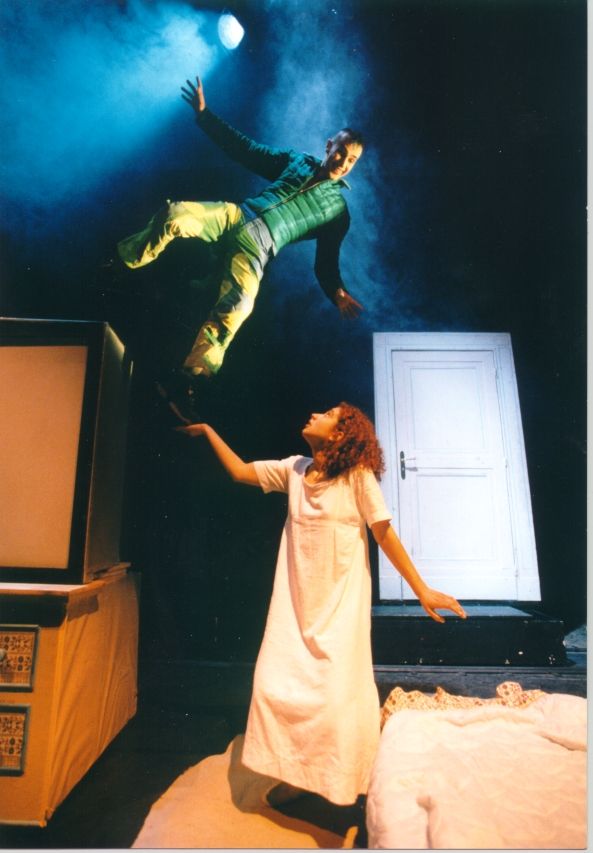
As the curtain rises we find Hermia in bed in her room with her boyfriend Sandro. It is almost dawn. The TV is on, showing a soap opera (Theseus and Hippolyta). Suddenly Hermia's father bursts into the room and catches them. Sandro is thrown out and Hermia is left alone in tears.
Strange interference comes from the TV: the image of an odd creature dressed in green crosses the screen several times until it comes out of the television and flies around the room. This end-of-millennium sprite is Puck, who takes Hermia back a few hours in time into a strange initiatory dream, into the underground of the metropolis, a world whose existence she never imagined. In this 'rusty wood' she meets her boyfriend Sandro, her friends Demetrius and Helena, and various night creatures: Oberon and Titania, the lords of the night, and Lisca, Storia and Pasticca, three rather spaced-out types trying to organise a rap concert.
The relationships between the four lovers are revealed and turned upside down by a strange flower that Oberon places on their eyelids, forcing them to fall in love with the first being they see when they wake. Titania thus falls madly in love with one of the spaced-out trio, Lisca, whom Puck has meanwhile turned into a monster. Sandro falls in love with Helena, and so does Demetrius. Finally an antidote from Oberon restores and corrects all these amorous exchanges and everything returns to how it was. The couples are reunited: Hermia with Sandro, Helena with Demetrius, Titania with Oberon.
At the final party the three spaced-out friends celebrate love restored with a wild rock concert that fades as Hermia wakes up. Puck, the true architect of the dream, vanishes magically before the eyes of Hermia and the audience, but reappears a second later to remind the spectators that humans… are such stuff as dreams are made on!
NOTE Dl REGIA
We tend to see Shakespeare as a legendary figure who has lost all human traits. So we sometimes find ourselves thinking of his work as if it had come down from heaven, rather than been written by a talented man of flesh and blood to entertain other people – amusing, fascinating, surprising, moving and dazzling them.
Our show starts from Shakespeare's “Dream”, using its extraordinary imaginative material and its mystery as a key to enter a contemporary journey: the journey of a girl through a city night, guided by a strange being – half guardian angel, half devil – among rubbish dumps and abandoned factories, places of a future mythology peopled by real and imagined young people. We tried to dig beneath the classical 'form' of this story to carve it alive, and not only from a critical point of view. We wanted a show that would look at us and concern us, and so – with the complicity of Francesca Zanni – we 'translated and betrayed' Shakespeare's text. In this show you will not find the Athenian court, the references to Greco-Roman and Celtic myths, or the somewhat defused buffoonery of clowns from five hundred years ago. And yet, paradoxically, we are convinced we have remained faithful to the original script, perhaps precisely because we treated it as a script and not as a monument.
A “Dream” we would like to be funny and unsettling, light and heavy like certain dreams we have at dawn, a few seconds before the alarm goes off, before we become what the night has taught us.
Duccio CameriniTournée season teatrale 1998-1999
Teatro Vaccaj Tolentino 29–30/01/1999
Teatro Piermarini Matelica 31/01/1999
Teatro Erba Torino 02–07/02/1999
Teatro Anibal Caro Civitanova 09/02/1999
Cine-teatro Livia Sant’Omero 10/02/1999
Teatro Comunale Teramo from 11 to 12/02/1999
Teatro Vittorio Emanuele Benevento 13–14/02/1999
Teatro Ariston Mondragone 15/02/1999
Teatro La Provvidenza Vallo della Lucania (SA) 16/02/1999
Teatro Partenio Avellino 17/02/1999
Cine-teatro Mercato San Severino (SA) 18/02/1999
Teatro Fiera Ancona 20–21/02/1999
Teatro Gloria Pomigliano d’Arco (NA) 23/02/1999
Teatro Politeama Torre Annunziata (NA) 24/02/1999
Teatro Gelsomino Afragola 25/02/1999
Teatro Telese Modernissimo 26/02/1999
Teatro Rendano Cosenza 27–28/02/1999
Teatro Circus Pescara 02–03/03/1999
Teatro Marchetti Camerino 04/03/1999
Teatro Marrucino Chieti 05–06/03/1999
Teatro Comunale Sulmona 07/03/1999
Teatro Ariston Campobasso 08/03/1999
Teatro Odeon Roseto degli Abruzzi 09/03/1999
Teatro Columbia Francavilla 12/03/1999
Teatro Izzo Caserta 13–14/03/1999
Teatro La Fenice Senigallia 16/03/1999
Teatro Fanin S. G. Persiceto 17–18/03/1999
Teatro Comunale Cossato 19/03/1999
Teatro Accademico Castelfranco Veneto 20–21/03/1999
Teatro Comunale Tortona 23–24/03/1999
Teatro Comunale Casale Monferrato 25–26/03/1999
Teatro delle Feste Bardonecchia 27/03/1999
Teatro Pax Cinisello Balsamo 29–30/03/1999
Teatro Edison Treviso 31/03/1999
Teatro Tenda Verona 01/04/1999
Teatro Astra Copparo 06/04/1999
Teatro La Dogana San Marino 07/04/1999
Teatro Accademico Bagni di Lucca 08/04/1999
Teatro Politeama Napoli 13–18/04/1999
Arena del Sole Bologna dal 20 al 25/04/1999
Teatro Sociale Rovigo 26/04/1999
Teatro Michelangelo Modena 27–29/04/1999
Teatro Comunale S. Felice Panaro 30/04/1999
Teatro Comunale Lanciano from 01 to 02/05/1999