
Potevo Far Fuori la Merkel, ma non L’Ho Fatto
Translated from the Italian. Titles, names, venues and press headlines are kept as originally published.
POTEVO FAR FUORI LA MERKEL, MA NON L’HO FATTO
STAY HUNGRY. STAY FOOLISH.
byFORTUNATO CERLINO
with
CESARE BOCCI Michele
FRANCESCO MONTANARI Modesto
CLAUDIA POTENZA Gloria
ROBERTA SPAGNUOLO Yvonne
Set design E COSTUMIMARIA TERESA PADULA
music E ORIGINALIPEPPE BRUNO
COLONNA SONORA A CURA DI MARCELLO COTUGNO
lighting designGIANLUCA CAPPELLETTI
assistant directorBEATRICE TOMASSETTI
REALIZZAZIONE VIDEO E FOTO DI SCENA ANDREA DE FUSCO
Assistant directorMARIANNA BOTRUGNO
TECNICO LUCI SAMUELE RAVENNA
TECNICO AUDIO/VIDEO MASSIMILIANO DE LELLIS
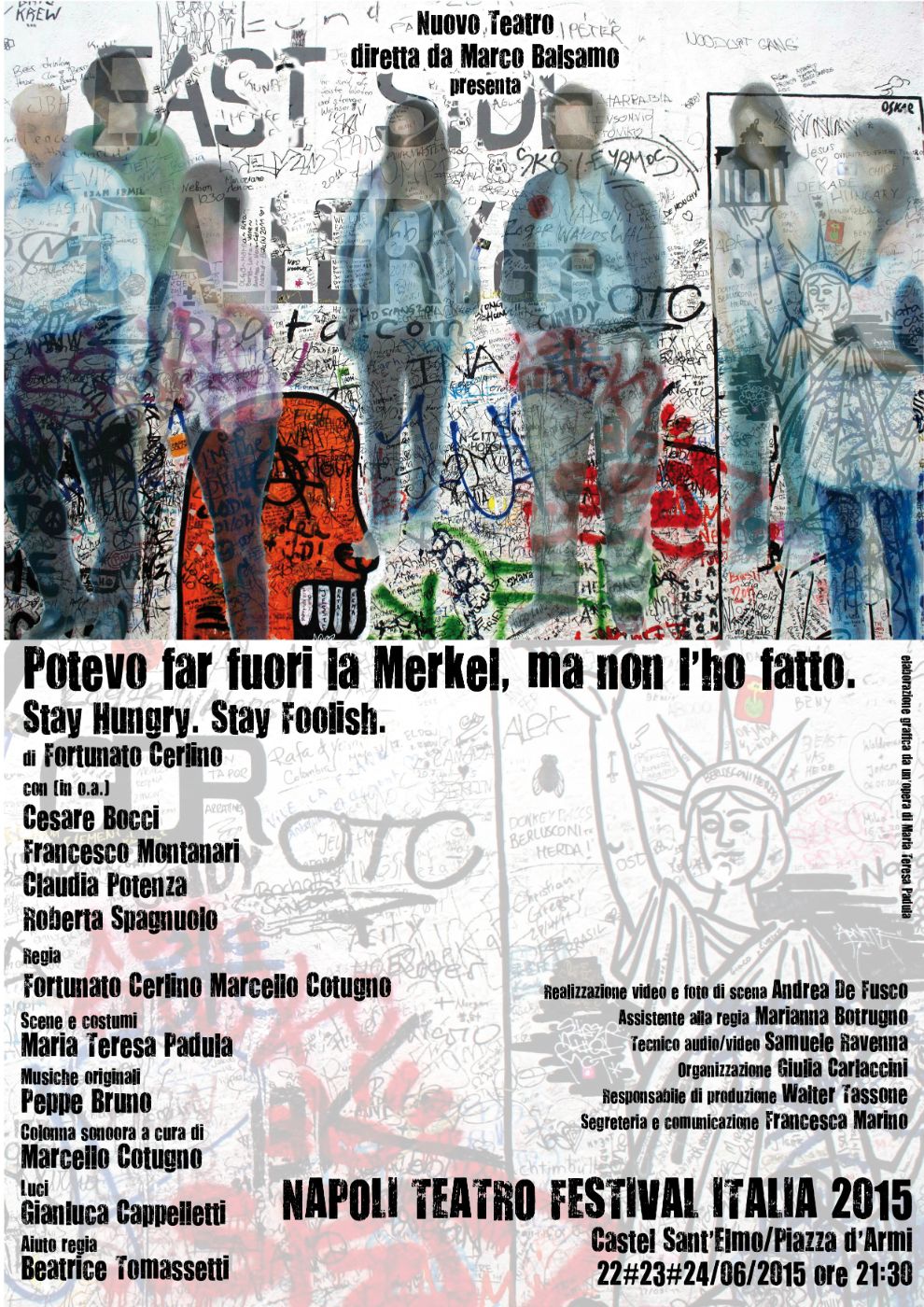
L’IMMAGINE DELLO SPETTACOLO È DELLA PITTRICE MARIA TERESA PADULA
Directed by
FORTUNATO CERLINO AND MARCELLO COTUGNO. After the great success of the TV series Gomorrah, Fortunato Cerlino is one of the most sought-after actors in Italian and international cinema. The actor and director presents a text he wrote himself, grotesquely titled Potevo far fuori la Merkel, ma non l'ho fatto (I Could Have Taken Out Merkel, But I Didn't). Co-directing with him is Marcello Cotugno, who with this play continues his long exploration of contemporary playwriting, after directing Neil LaBute's Some Girl(s) and Claudio Fava's Novantadue – Falcone e Borsellino vent'anni dopo in 2014/15.
An apartment building where four characters live. Michele and Yvonne have three children and their marriage is in deep crisis. He is a successful psychoanalyst, attractive and charming – a successful public man, but with a private life that is collapsing and threatens to sweep him away. She realises she married too young, had too many children, has not yet lived and perhaps never will. Then there is Gloria, his patient and her friend, who dreams of living in Berlin because 'Germany is inside history'. Steve Jobs is her guru, the last genius born into this world, who was able to change his life because he was a brave visionary capable of fighting conformism. Finally there is Modesto, a 38-year-old heroin addict supported by his mother, who spends his days memorising Jobs' Stanford speech and watching porn. They call him Steve because, just like Jobs, he could have been a genius but was unable to believe in himself; he lives in a stalemate he calls honest, and until he has an original idea of his own he prefers to watch the world rather than become an insignificant shadow in it.
In the background, a raw, often clumsy and bitterly comic analysis of contemporary Italy and its relationship with other European countries, particularly Merkel's Germany. Italy, like Germany, was given by history the chance to undergo a radical change – a metanoia that after the Second World War could have made our country a world point of reference. From the rubble of the fall of the Berlin Wall, however, Germany emerged victorious and strong, while Italy, with its politics of weak governments, a weak lira and speculation, ended up weakening its identity and its chance of redemption.
Note by directed by
The long journey around the German heart of Europe leads to a redefinition of Germany's role in the current crisis: it is up to the Germans to take on the historic responsibility of saving Europe, after sinking it twice in the past. And they must exercise the hegemony that falls to them with wisdom and foresight.
Angelo Bolaffi
Yes, mother – Yegor replies – when there's light you can't see anything, but
as soon as it's dark you can see everything.
Israel Joshua Singer
Everything begins with a door left ajar. It is the door of Modesto's flat, which he leaves half open – perhaps unconsciously – to let a glimmer of real life into his reality of loneliness and apathy.
The door, in Hitchcock fashion, is the pretext, the anti-naturalistic engine that sets off the mechanism of the story, which portrays four desperate people, four children of the crisis teetering on the edge of an existential precipice.
Modesto's reality thus appears motionless, frozen in a freeze-frame that seems captured by his own videos, in which he loves to film himself quoting Steve Jobs' speeches. As motionless as that of Yvonne, trapped in her marriage to a successful man, Michele, who only seemingly stands apart from this parade of minor failures; or that of Gloria, who pursues the dream/cliché of moving to Germany (a paradoxical brain drain, however, which will see her emigrate to work as a supermarket assistant).
The scenes follow one another in a few settings – Modesto's home, Michele's psychoanalyst's office, a university lecture room, an interview office – which all refer back to a single scene, a kind of ring where the characters face each other and fight, unaware of the ordinary madness they are living, immersed in a hyper-realistic reality that devours them without leaving them room even to catch their breath.
The storytelling has the cut of a psychological thriller, but the suspense only seemingly drives the story: four characters are victims of a story that cannot really be changed and, in line with postmodern playwriting, they raise questions they cannot answer, leaving that task once again to the audience.
The paroxysmal degeneration of the society of the spectacle leaves us no escape: it puts us more and more on display, spying on us at every moment of our lives, and so
the actor-characters too cannot really leave the stage; they remain protagonists of their own existence – an existence sabotaged by their own inaction, which perhaps in the end will find a glimmer of light but which, probably, two minutes after the curtain falls and hidden from our eyes, will plunge back into darkness.
A concrete floor made from pieces of the Berlin Wall reveals the concrete jungle designed by Maria Teresa Padula, who also designed the costumes, in which today's caged man seeks an escape from the absurdity he lives in, while a perimeter around it serves as an on-view dressing room where the actors take refuge between rounds. The sharp, acid lighting is by Gianluca Cappelletti, while Peppe Bruno's original music draws on minimal electronica and rock, alongside existing music, in a crossover of genres ranging from the anthem of the GDR (where Merkel lived for 37 years) to the most sophisticated techno of Rival Console.
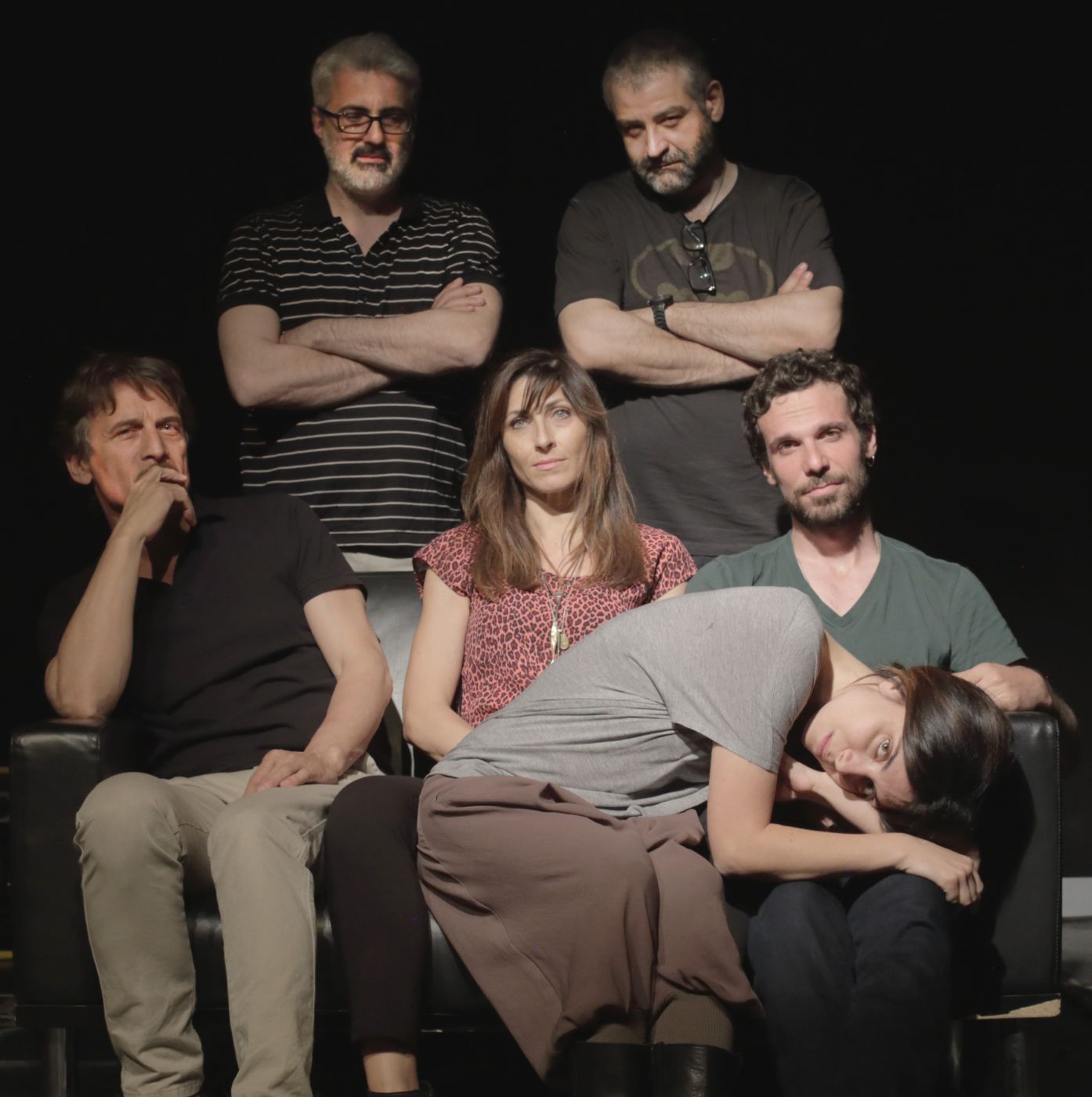
A cast of leading actors: Cesare Bocci as the successful, unscrupulous psychiatrist; Francesco Montanari as the silent, methodical Modesto; Claudia Potenza as the impetuous, uninhibited Gloria; Roberta Spagnuolo as the fragile, borderline Yvonne. The result is a portrait that – between unintentional comedy, foretold drama and metatheatre – analyses without judgement a time of crisis and the thin line separating a normal existence from one in which a decisive, definitive action can upend and change the meaning of a whole life.
Fortunato Cerlino # Marcello Cotugno